Trying to lose weight through exercise can become unnecessarily complicated. One plan says to spend an hour on the treadmill. Another insists that heavy strength training is the only answer. Somewhere else, a fast-paced circuit promises dramatic results in a matter of weeks.
The truth is less dramatic, but more useful. Full body workouts to lose weight can be highly effective because they train several major muscle groups within the same session. Instead of isolating one small area, they ask the legs, back, chest, shoulders, arms, and core to work together. This usually creates a more demanding workout, improves overall fitness, and makes efficient use of limited time.
Still, exercise is only part of weight loss. Nutrition, sleep, stress, daily movement, and consistency all matter. A good full-body routine supports that wider process. It does not need to feel punishing, and it certainly does not need to leave you exhausted for the rest of the day.
Why Full Body Training Works Well for Weight Loss
Weight loss occurs when the body consistently uses more energy than it receives from food and drink. Exercise contributes by increasing energy expenditure, but its benefits go beyond the calories burned during a single session.
Full-body training recruits multiple muscles at once. A squat-to-press, for example, involves the legs, glutes, core, shoulders, and arms. A row challenges the upper back and arms while the core stabilizes the body. Because more muscles are active, the cardiovascular system also has to work harder.
Strength-based full-body sessions can help preserve muscle while body weight is decreasing. This is important because losing weight without resistance training may result in the loss of both fat and lean tissue. Maintaining muscle supports physical strength, movement quality, and long-term weight management.
These workouts are practical too. Rather than training a different body part every day, many people can make progress with two to four balanced sessions each week.
The Best Exercises Use Natural Movement Patterns
An effective full-body workout does not require dozens of exercises. It is usually built around a few basic movement patterns that reflect how the body naturally functions.
Squatting movements train the thighs, hips, and glutes. Hinges, such as deadlifts or hip thrusts, focus more on the back of the legs and hips. Pushing exercises work the chest, shoulders, and triceps, while pulling movements train the back and biceps.
Core exercises improve stability and help transfer force between the upper and lower body. Carrying, stepping, rotating, and crawling movements can also add variety while increasing the overall demand of a session.
The specific exercise matters less than choosing a version that suits your ability. A beginner might perform squats to a chair, wall push-ups, supported rows, and standing knee raises. Someone with more experience may choose weighted squats, push-ups from the floor, dumbbell rows, and planks.
Progress comes from gradually making these movements more challenging, not from starting with the hardest possible version.
Strength Training Should Be the Foundation
Cardio is often the first thing people think about when considering full body workouts to lose weight. Running, cycling, and aerobics certainly have a place, but strength training deserves equal attention.
Resistance exercises challenge muscles to work against an external load. That load may come from dumbbells, resistance bands, gym machines, or body weight. Over time, the body adapts by becoming stronger and more capable.
Strength training may not always produce the same immediate calorie reading as an intense cardio session, but it supports muscle retention and improves functional fitness. It can also make everyday activities feel easier, from climbing stairs to carrying groceries.
A simple strength session might include a squat, a hip hinge, a push, a pull, and a core movement. Performing these exercises in a circuit keeps the workout moving and raises the heart rate without turning every session into a frantic race.
Good form should remain the priority. Moving more quickly is not helpful when posture, joint control, or breathing begins to break down.
Cardio Can Increase the Energy Demand
Cardiovascular exercise strengthens the heart and lungs while increasing calorie expenditure. It can be included within a full-body routine or performed separately.
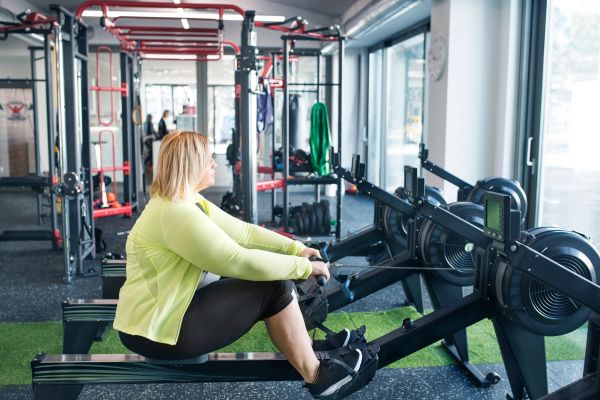
Low-impact options such as brisk walking, swimming, cycling, rowing, or using an elliptical machine are often easier to recover from than frequent high-impact training. They are particularly useful for beginners, people carrying extra body weight, or anyone managing sensitive joints.
Short bursts of faster activity can also be effective. A workout might alternate between moderate and slightly harder periods rather than maintaining one pace throughout. This approach is often called interval training.
Intervals do not need to involve all-out sprints. For many people, alternating one minute of faster walking with two minutes at a comfortable pace is challenging enough. The intensity should match current fitness, not an idealized image of what exercise is supposed to look like.
Combining strength work with sensible cardio creates a balanced approach that supports both fat loss and general health.
A Simple Full-Body Workout Structure
A practical session begins with a warm-up. Five to ten minutes of gentle movement can raise body temperature and prepare the joints. Walking, arm circles, easy bodyweight squats, hip hinges, and controlled lunges are all useful options.
The main workout can then include five or six exercises covering the major movement patterns. Each exercise may be performed for a set number of repetitions or for a timed interval, followed by a brief rest.
For example, a session could include chair squats, incline push-ups, resistance-band rows, glute bridges, alternating step-backs, and dead bugs. These movements train the lower body, upper body, and core without requiring complicated equipment.
The circuit may be repeated two or three times depending on fitness and available time. A short cool-down at the end allows breathing and heart rate to settle gradually.
This type of session can take less than forty minutes. When performed consistently, it is far more useful than an extreme workout attempted once and then abandoned.
Intensity Matters, but More Is Not Always Better
A workout should feel challenging enough to create adaptation, yet manageable enough to repeat regularly. Many people assume that soreness, heavy sweating, or complete exhaustion proves that a session was effective. None of those things is a reliable measure of progress.
During strength exercises, the final few repetitions should feel difficult while remaining controlled. During cardio, breathing may become faster, but intensity should not rise so high that technique disappears or recovery takes several days.
Training too hard too often can interfere with consistency. It may increase fatigue, reduce motivation, and make everyday movement less appealing. Someone who is constantly sore may unconsciously sit more during the rest of the day, reducing some of the benefit created by the workout.
Moderate training performed week after week usually beats aggressive programs that cannot be sustained.
Progression Keeps the Body Adapting
The body becomes efficient at activities it performs regularly. A workout that once felt difficult may become comfortable after several weeks. This is a sign of improvement, but it also means the routine may need to progress.
Progression can involve adding a little weight, performing more repetitions, increasing the number of rounds, improving range of motion, or reducing rest periods slightly. Changing to a more challenging exercise variation is another option.
Only one or two elements need to change at a time. Increasing everything at once makes it harder to understand how the body is responding.
Progress should also be measured beyond the scale. Better stamina, heavier lifts, improved balance, a smaller waist measurement, and easier daily movement all show that the training is working.
Body weight can fluctuate because of hydration, hormones, digestion, and salt intake. Looking at broader trends gives a more accurate picture.
Recovery Supports Better Results
Exercise creates the stimulus for change, but recovery is when the body adapts. Rest days are therefore part of the plan rather than a sign of laziness.
Most beginners do well with at least one day between demanding full-body strength sessions. Light walking, mobility work, or gentle cycling can be performed on recovery days if it feels comfortable.
Sleep also affects hunger, energy, and workout performance. When sleep is consistently poor, cravings may become harder to manage and exercise may feel more difficult than usual.
Protein-rich meals, adequate hydration, and a generally balanced diet help support recovery. Weight loss does not require eliminating entire food groups or surviving on very small meals. A moderate calorie deficit is usually more sustainable than severe restriction.
Anyone with a medical condition, injury, pregnancy, significant joint pain, or a long period of inactivity should speak with an appropriate healthcare professional before beginning an intense exercise program.
Consistency Makes the Routine Effective
The most carefully designed workout cannot help if it does not fit real life. A realistic schedule matters more than an impressive one.
Three full-body sessions each week may be enough for steady progress, especially when combined with regular walking and mindful eating. Some people prefer shorter workouts performed more frequently. Others do better with longer sessions on fewer days.
It helps to treat exercise as a normal appointment rather than a temporary punishment for gaining weight. Choose convenient times, prepare clothing in advance, and keep home-based alternatives for busy days.
Missing one workout is not failure. The important step is returning to the routine rather than waiting for another perfect Monday.
Conclusion
Full body workouts to lose weight are effective because they combine strength, movement, and cardiovascular effort in a time-efficient format. They can help burn energy, preserve muscle, improve fitness, and make everyday tasks easier.
The strongest routine is not necessarily the most intense. It is the one that includes balanced movement patterns, sensible progression, adequate recovery, and exercises that match the individual’s current ability.
Weight loss usually happens gradually, and exercise works best when it supports a sustainable lifestyle rather than dominating it. With steady effort, patient adjustments, and realistic expectations, full-body training can become more than a short-term weight-loss method. It can become a lasting way to feel stronger, move better, and take better care of the body.